Authors: Ari Fuchs & Denis Pozigun
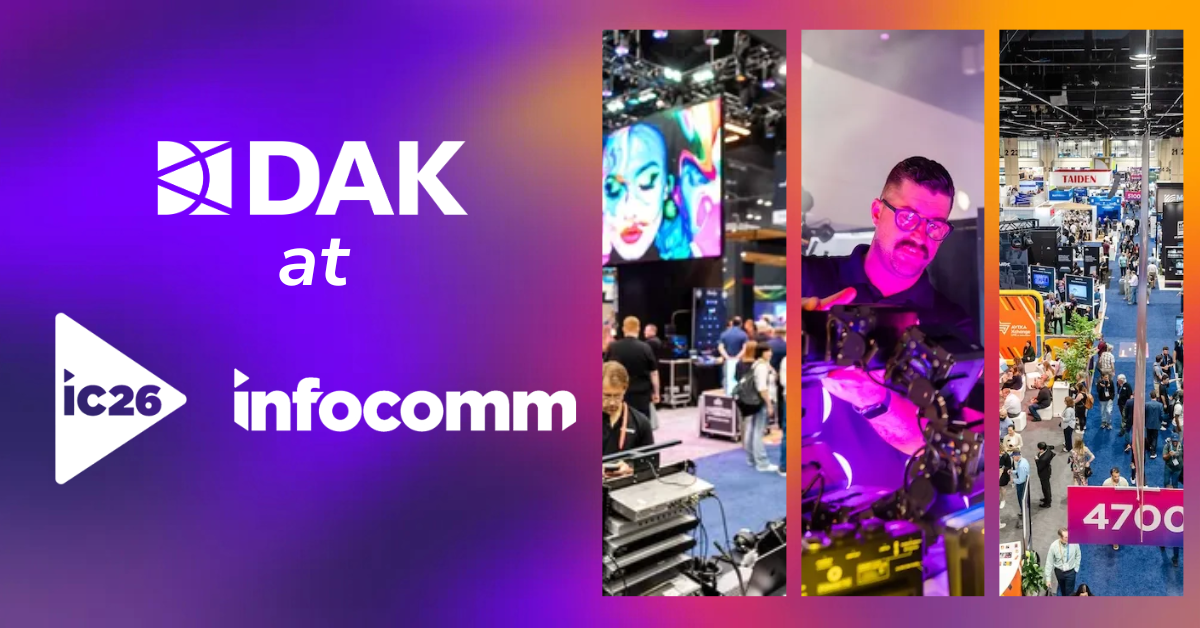
Earlier in June, The DAK Group attended InfoComm, North America’s largest professional audiovisual trade show and one of the premier gatherings for integrators, manufacturers, end users, investors and business leaders. The event provided an opportunity to meet with business owners and executives from across the global commercial integration marketplace and discuss the trends shaping growth, investment activity and consolidation across the sector.
While technology innovation remains a key driver of growth, many of the conversations at this year’s event centered less on products and more on business strategy. Across the industry, successful integrators that were independently owned just a few years ago have become part of larger regional, national and global platforms. As consolidation continues and customers demand broader capabilities, owners are increasingly asking themselves important questions: How do we continue to grow? How do we differentiate ourselves in a market where many services are becoming increasingly commoditized? And what characteristics will make certain businesses more attractive than others to strategic buyers, private equity investors and potential partners in the years ahead?
Several themes consistently emerged throughout the week.
1. The Industry Continues to Get Bigger—and Smaller at the Same Time
- One topic that surfaced repeatedly at InfoComm was how much the competitive landscape has changed over the last several years.
- Large integrators continue to expand through acquisitions, opening new offices and adding capabilities that allow them to support customers nationally and globally.
- At the same time, many smaller firms are finding success by focusing on specific vertical markets, specialized technologies or deep local customer relationships.
- This dynamic is creating a market that is increasingly divided between scaled platforms and highly specialized providers, with fewer companies competing in the middle.
Owner’s Perspective
Whether you’re building a national platform, expanding internationally or operating a highly specialized regional business, the middle ground is becoming more difficult to defend. Many of the industry’s larger players are investing in global delivery capabilities to support multinational customers, while others are differentiating through deep expertise, niche markets or exceptional local relationships.
Owners should be asking themselves what makes their company truly unique—and whether that differentiation will become even more valuable as the industry continues to consolidate. Increasingly, acquirers are not simply looking for revenue. They are looking for capabilities, customer relationships, scalability, geographic reach and specialized expertise that complement their existing platform. Companies that can clearly articulate what makes them different are often the ones that attract the greatest interest from buyers and investors because those same qualities also help drive stronger customer loyalty, sustainable growth and long-term profitability.
2. Everyone Wants More Recurring Revenue
- Integrators continue to look for ways to move beyond a business model that depends entirely on the next project.
- Service agreements, monitoring, support contracts and managed meeting room services were common topics throughout the show.
- Many business owners acknowledged that recurring revenue creates stronger customer relationships while helping smooth out the natural ups and downs of project work.
- Customers also appear increasingly willing to outsource ongoing technology management rather than maintaining those resources internally.
Owner’s Perspective
The companies creating the most long-term value are finding ways to stay connected to customers after the project is complete. Recurring revenue not only provides greater stability, it often creates stronger customer relationships and more opportunities for future growth. It is also a key characteristic sought by both strategic acquirers and private equity investors evaluating opportunities.
3. The Lines Between AV, IT and Security Keep Blurring
- Several years ago, AV, IT and physical security were often managed by separate teams and separate vendors.
- Today, many projects involve all three.
- Integrators are being asked to understand networks, collaboration platforms, cybersecurity requirements, access control systems and workplace technologies in addition to traditional AV solutions.
- As a result, companies are expanding their capabilities and hiring talent from outside the traditional AV industry.
Owner’s Perspective
Customers care less about industry labels than they do about solving problems. Owners should evaluate whether their capabilities are keeping pace with customer expectations and whether they are positioned to participate in larger, more strategic projects as technology environments continue to converge. As the market evolves, companies that successfully bridge multiple disciplines are often creating differentiation that is difficult to replicate and increasingly attractive to customers, partners and potential acquirers.
4. Customers Are Looking for Fewer Partners
- Many enterprise customers expressed a desire to simplify vendor relationships and standardize technology deployments across multiple locations.
- Rather than managing different integrators in different regions, organizations increasingly want partners that can provide consistent execution across their entire footprint.
- As more companies expand internationally, the ability to support customers across multiple countries and regions is becoming increasingly important.
- This trend is benefiting larger providers but also creating opportunities for regional firms that can demonstrate specialized expertise or strong service capabilities.
Owner’s Perspective
Being technically capable is no longer enough. Increasingly, customers want trusted partners who can support them across locations, business units and, in many cases, countries. As organizations continue to expand globally, integrators are being challenged to deliver consistent customer experience regardless of geography. Companies that can scale with their customers either organically, through partnerships or through acquisitions are often in the strongest position to win long-term relationships.
5. Global Capabilities Are Becoming a Competitive Advantage“
- As enterprise customers continue to expand internationally, many integrators are being asked to support projects across multiple countries and regions.
- Several conversations at InfoComm highlighted the growing importance of delivering a consistent customer experience regardless of geography.
- To meet these requirements, many companies are investing in international infrastructure, strategic partnerships and cross-border service capabilities.
- At the same time, mergers and acquisitions continue to play an important role in helping firms expand their geographic footprint, enter new markets and support multinational customers more effectively.
Owner’s Perspective
As customers grow globally, many integrators are finding they need to grow alongside them. For some companies, that means building international capabilities organically. For others, it means pursuing acquisitions, partnerships or strategic alliances that provide access to new markets and customers. Increasingly, geographic reach is becoming more than a growth initiative—it is a competitive differentiator.
Companies that can support customers across multiple regions are often better positioned to win larger opportunities, strengthen client relationships and attract interest from strategic buyers and investors seeking broader platform capabilities.
Looking Ahead with The DAK Group
The conversations at InfoComm made one thing clear: the characteristics that help companies win customers today are increasingly the same characteristics that attract buyers, investors and strategic partners tomorrow. Whether the goal is accelerating growth, expanding capabilities, entering new markets or preparing for a future transaction, owners are placing greater emphasis on building businesses that are differentiated, scalable and positioned for long-term success. One theme that surfaced repeatedly throughout the event was the growing importance of global capabilities, as more integrators look to support customers across multiple countries and follow clients into new markets. As enterprise customers continue to expand internationally, the ability to deliver consistent service and support on a global scale is becoming an increasingly important competitive differentiator.
The DAK Group works with business owners to understand their strategic options and capitalize on opportunities created by evolving market conditions.
Reach out to discuss how the trends highlighted at InfoComm 2026 may influence your company’s growth or exit strategy, acquisition opportunities and long-term positioning in an increasingly active M&A market.